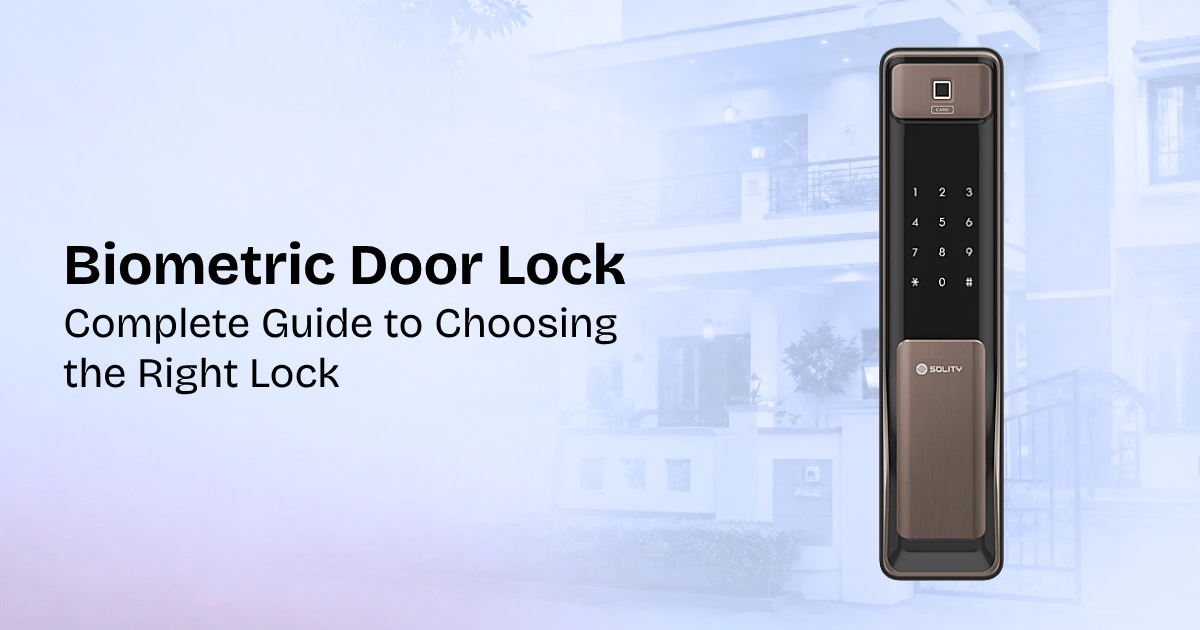
A biometric door lock opens using your fingerprint, palm, or face instead of a key. It is ideal for homes, apartments, offices, and commercial spaces. Choose a lock that suits your door and features reliable sensors and backup access options.
Keys get lost. Keys get copied. Keys get left in your other jacket. A biometric door lock skips that entire drama. It reads something you already carry everywhere: your fingerprint, your palm, sometimes your face, and lets you in without a single jingling keychain.
This guide breaks down how a biometric door lock actually works, where it fits best, what it costs, and how to pick the right one according to your requirements.
What is a Biometric Door Lock?
A biometric door lock replaces your key or serves as a backup to it by scanning a specific physical characteristic. Most home models use fingerprint sensors. Models that recognize palm veins or facial features are also available.
How it works in three steps:
- The sensor scans your fingerprint ridge pattern.
- The lock converts the scan into an encrypted digital template. It does not store a photo.
- The lock compares each new scan with its stored templates. A match opens the door. No match keeps it locked.
How Accurate Is a Biometric Lock?
Two measures define accuracy:
- False Acceptance Rate (FAR): How often the lock admits an unauthorized person.
- False Rejection Rate (FRR): How often the lock rejects an authorized person.
How Does a Biometric Door Lock System Work?
Three technologies dominate the market right now, each with its own strengths.
| Technology | How it works | Best for | Main limitation |
|---|---|---|---|
|
Fingerprint |
Scans ridge patterns |
Homes, apartments, offices |
Wet or dirty fingers can cause rejections |
|
Palm-vein |
Scans vein patterns with near-infrared light, no touch needed |
Shared and high-traffic spaces |
Higher cost |
|
Facial recognition |
Uses a camera to match a face |
Commercial and enterprise sites |
Photos or video can fool it without liveness detection |
Biometric Door Lock for Home
A biometric door lock for home solves a problem every parent, pet owner, and forgetful adult understands: too many people, too few spare keys. Kids walking home from school don’t need a key hidden under a fake rock. They just need a finger.
There are more people in a home than there are keys. Parents, children, helpers, and guests, everyone needs to come and go. Fingerprints provide a solution to this problem.
Backup access is essential. The battery could run out at any time. A lock that leaves you stranded outside can cause significant trouble. Always choose a model that offers the option to unlock it using a PIN code or a physical key.
A few things worth checking before buying one for your front door:
- Weatherproofing – Front doors face sun, rain, and dust. A lock rated for outdoor use will hold up better over time.
- Battery life – Look for models that give a low-battery warning well before they die completely.
- App and remote access – Many home units let you grant or revoke access remotely, which is handy for guests, contractors, or a dog walker who only needs access on Tuesdays.
Biometric Door Lock for Apartments
A biometric lock suits apartments because it removes shared keys and lost-key calls. Residents enter with a fingerprint. Owners can add or delete users quickly, which helps when tenants change.
Why apartments benefit:
- Tenant turnover: Delete one user. No need to change the lock.
- Guest access: Give short-term access to visitors, relatives, or house help.
- No lost keys: Nothing to copy, hide, or hand over.
Biometric Door Lock for Office
A biometric door lock used in an office controls who enters and when, while also maintaining a record of these entries. Fingerprints cannot be shared or copied at a hardware store, nor can an employee retain access after leaving the job. The administrator has access to the complete entry log.
There is a common problem in offices: who still has the key to the three jobs? Biometrics eliminate this question.
Office-grade units typically support far more enrolled users than home models, along with role-based access, so the cleaning crew can get into the lobby without also getting into the server room.
Key benefits:
- No copied keys: Each fingerprint belongs to one person.
- Access logs: See whose fingerprint opened the door, and when. This helps during audits and is easier than reviewing CCTV footage.
- Role-based access: Give each group only the doors it needs.
Biometric Lock for Glass Door
A biometric lock for glass doors is a slim unit that attaches to the edge of the glass, requiring no drilling. It preserves the clean aesthetic of frameless panels while offering the convenience of fingerprint access.
Glass doors are commonly found in offices, showrooms, and modern homes. However, their design presents a challenge: bulky mechanical locks look unsightly, and there is no space to install a standard deadbolt.
Before you order:
- Measure your glass thickness.
- Check the lock’s clamp range.
- Confirm the door type and handle position.
Biometric Door Locks for Business
For businesses, biometric door locks provide control over access and a record of it. Managers can add or remove multiple employees at once, set schedules, and generate compliance reports. This is superior to shared keypad codes that everyone including former employees remembers.
For retail stockrooms, server closets, and pharmacy cabinets, knowing “who has access?” is crucial; biometric systems provide the answer.
Typical business features:
- Bulk user management: Add or remove many employees at once.
- Time-based access: Limit entry to shift hours.
- Compliance reports: Export logs for audits.
- Centralized dashboard: Manage every branch from one screen.
Biometric Door Lock Price: What Determines the Cost?
The price of a fingerprint door lock for the home can range from ₹10,000 to over ₹1,00,000. The cost depends on the sensor quality, the brand, and the accompanying features. Basic units are the most affordable, while features such as smart connectivity, higher user capacity, and multi-modal scanning drive up the price.
| Tier | What you typically get |
|---|---|
|
Basic |
Fingerprint sensor, backup key or PIN, no smart features |
|
Mid-range |
Fingerprint plus app control and remote access logs |
|
Advanced |
Heavy-duty hardware, high user capacity, or multi-modal scanning (fingerprint plus palm or face) |
What drives the price:
- Sensor quality
- Brand
- Smart features (app, remote access)
- User capacity
- Build strength
How to Choose the Best Biometric Door Lock in Ahmedabad
The best biometric door lock depends on how you intend to use it; warehouses and studio apartments require different types of locks. Consider factors such as the sensor type, backup access options, build quality, and user capacity.
Your buying checklist:
- Sensor type and accuracy: Optical sensors are cheaper; capacitive sensors generally read fingerprints more reliably and resist spoofing better.
- Backup access: A PIN, key card, or physical key override keeps you from being stranded.
- Build Quality and Certifications: Look for recognized security or weatherproofing ratings relevant to your region.
- User capacity: Homes rarely need more than a handful of profiles; offices need dozens or hundreds.
- Installation and service: Choose a best smart door lock supplier in Ahmedabad that offers local installation and after-sales support.
Final Thoughts
Biometric smart door locks replace a pocketful of keys with a simple scan. This is a beneficial solution for most homes and businesses. This technology is no longer just a gimmick or a showy feature; the sensors have improved, recognition is reliable, and installation is easy.
Remember three rules:
- Match the lock to your door and building.
- Count how many people need access.
- Always budget for a backup entry method.
Ready to choose? JAL Digital System is a digital door lock supplier in Ahmedabad. We serve homes, apartments, offices, and commercial spaces. Visit our showroom today and we’ll help you pick the right smart lock for your needs.
FAQs about Biometric Smart Locks
No lock is unhackable, but biometric locks are harder to bypass than traditional keys since fingerprints can’t be duplicated or picked like a lock cylinder. The bigger risks are software vulnerabilities or poor-quality sensors. Choosing a reputable brand with encrypted local storage and regular firmware updates significantly lowers real-world hacking risk.
Quality biometric locks warn users well before the battery fully drains and include a backup entry method, such as a PIN code, key card, or physical key override. Some models also allow emergency power through a USB port or 9-volt battery contact. Always confirm backup access exists before installing one at your main entrance.
A smart lock typically unlocks via app, keypad, or Bluetooth key fob, while a biometric lock uses a physical trait like a fingerprint or palm vein as the primary credential. Many modern digital door locks combine both, offering biometric access as the main method with app or PIN access as a backup option
Fingerprint recognition is the more established option for doors, offering fast, reliable matching and wide availability. Facial recognition is more common in commercial settings and is more vulnerable to spoofing through photos or video without added liveness detection. For most home and office doors, fingerprint sensors remain the stronger everyday choice.
Yes. Most biometric locks support multiple enrolled fingerprints, and capacity varies by model. Home locks usually handle a handful of users comfortably, while office and business-grade systems support dozens or hundreds of profiles, often with role-based access so different groups can be restricted to specific doors or time windows.
